

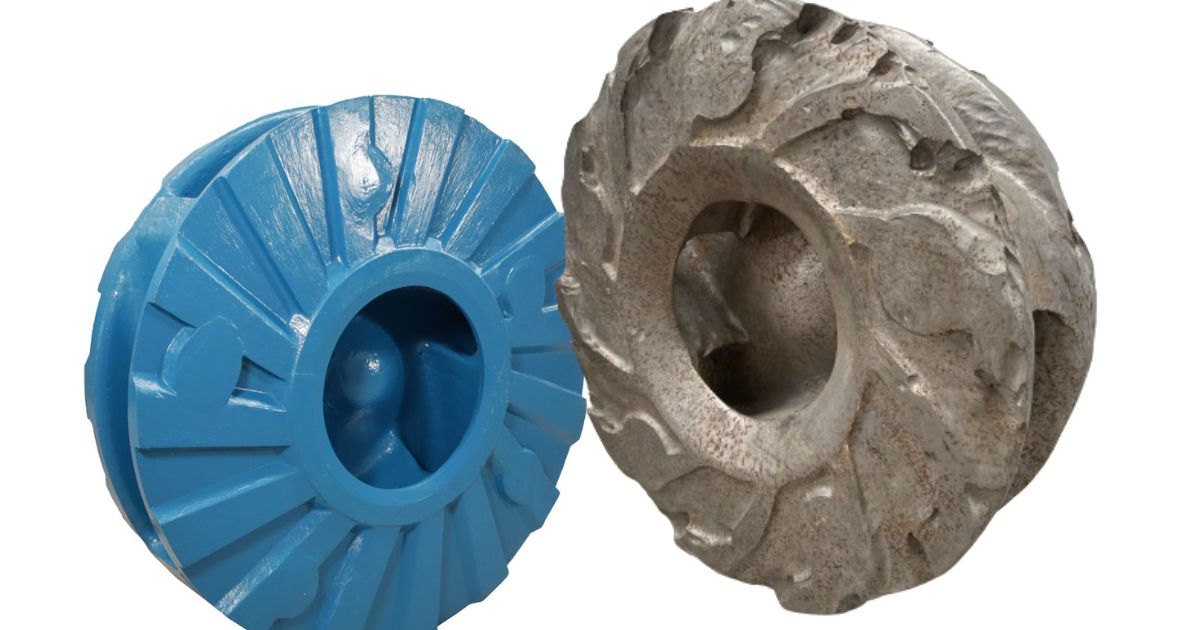
A pump that has been running trouble-free for months suddenly starts sounding like it is dragging gravel. Flow rate drops, discharge pressure fluctuates, and the impeller shows pitting that was not there during the last inspection. Many maintenance teams assume cavitation — and they are often right. But acting without confirming the root cause turns a quick fix into weeks of trial and error.
This article serves as a diagnostic guide for a single failure mode: cavitation in centrifugal pumps. You will find how to confirm it in the field, what causes it, how to distinguish it from problems that look similar, and what to correct first. Everything is geared toward helping you make decisions without tearing down the pump prematurely.
Key Terms
– NPSHa (NPSH available): Absolute energy of the liquid at the pump suction above its vapor pressure. This is a property of the system, not the pump.
– NPSHr / NPSH3: NPSH required by the pump; by Hydraulic Institute definition, it is the NPSHa that causes a 3% reduction in total head of the first-stage impeller. This value is designated NPSH3.
– Aeration: Atmospheric air entering the pumped fluid, typically through leaks in seals or suction connections.
– Recirculation: Reversed flow inside the impeller when the pump operates far from its best efficiency point (BEP), either due to excess or insufficient flow.
– BEP (Best Efficiency Point): Flow rate at which the hydraulic design of the impeller operates at maximum efficiency and minimum dynamic load.
What Cavitation Is and Why It Destroys Performance Before It Destroys Parts
Cavitation occurs when the pressure of the pumped liquid drops below its vapor pressure, vapor cavities form, and then collapse as pressure recovers (Hydraulic Institute, Pump FAQs). These collapses generate localized shock waves that erode the impeller metal and the inlet area.
What many overlook: visible damage is the last stage. The pump loses hydraulic performance (head and flow) long before pitting appears. Vapor bubbles block fluid passage inside the impeller, reduce hydraulic efficiency, and increase vibration — all without an external visual inspection revealing anything obvious.
⚠️Warning: If discharge pressure drops progressively and the sound changes without any modification to the operating point, the pump may be cavitating. Do not wait until you see impeller erosion before taking action.
How to Identify Cavitation in the Field: Signs, Symptoms, and Damage Patterns
Audible and operational signs
- Gravel-like or rattling noise in the pump casing, particularly near the suction.
- Abnormal vibration not explained by mechanical unbalance or misalignment.
- Drop in flow rate or discharge pressure with no change in the control valve or system demand.
- Increase in fluid temperature at the pump discharge, resulting from internal turbulence.
Typical damage pattern
Cavitation damage concentrates near the impeller eye and on the low-pressure face of the vanes. You will see irregular pitting, as if the metal had been struck point by point — different from the uniform wear caused by abrasion.
💡Tip: If you inspect the impeller and find erosion concentrated at the eye and vane inlet, but the discharge surfaces are clean, the pattern points to classic cavitation from insufficient NPSH. If the damage appears on the pressure face of the vanes or near the discharge, investigate recirculation before assuming suction cavitation.
Most Common Root Causes
If the NPSHa supplied to the system is insufficient relative to the pump’s NPSHr / NPSH3, cavitation will occur (Hydraulic Institute, Pump FAQs). The base formula for calculating NPSHa is:
$$ NPSHa = h_{atm} + h_s - h_{vp} - h_f $$
Where:
- \( h_{atm} \) = local atmospheric pressure, converted to liquid head (m or ft)
- \( h_s \) = static suction head (positive if the liquid level is above the pump centerline; negative if below)
- \( h_{vp} \) = vapor pressure of the liquid at operating temperature, in liquid head
- \( h_f \) = friction losses, fittings, and restrictions in the suction line
Inlet losses, valves, fittings, and friction in the suction line reduce the margin (Hydraulic Institute, Pump FAQs / HI Data Tool).
Causes organized by field frequency
| Root Cause | How It Reduces NPSHa | Associated Sign |
|---|---|---|
| Low liquid level in tank or sump | Directly reduces \( h_s \) | Intermittent noise that disappears when level rises |
| Excessive losses in suction line (clogged strainer, partially closed valve, undersized piping) | Increases \( h_f \) | Low reading on suction gauge |
| High fluid temperature | Increases \( h_{vp} \) | Cavitation worsens during hours of higher ambient temperature |
| Air or gases trapped in the suction line | Reduces the effective pressure of the liquid | Pump starts with irregular noise; visible foam |
| Low submergence of the suction piping | Allows vortex formation and air entry | Visible vortex in the tank or sump |
| Operation far from BEP | Locally increases the required NPSH | High vibration, performance below the curve |
✓Decision point: Before modifying the pump, check with the table above whether the cause lies in the system. In most field cases, the problem is in the suction or operating conditions, not the pump itself.
Cavitation vs. Aeration vs. Recirculation: How Not to Confuse the Diagnosis
These three conditions share symptoms — noise, vibration, performance loss — but have different causes and different corrections. Misdiagnosing means fixing something that is not the problem.
| Criterion | Cavitation | Aeration | Recirculation |
|---|---|---|---|
| Mechanism | Local pressure drops below vapor pressure; vapor bubbles form and collapse | Atmospheric air enters the fluid through leaks in seals, connections, or low submergence | Flow reverses inside the impeller when operating far from BEP |
| Typical Noise | Continuous gravel or rattling | Bubbling or crackling sound, sometimes intermittent | Rhythmic knocking or low-frequency pulse |
| Damage Zone on Impeller | Impeller eye and low-pressure face of the vanes | No typical erosion pattern; can cause accelerated corrosion | Pressure face of the vanes (discharge recirculation) or impeller eye inlet (suction recirculation) |
| Relationship to Flow Rate | Appears or worsens when NPSHa drops (low level, restricted suction, high temperature) | Independent of flow rate; depends on suction integrity | Appears at very low or very high flow rates relative to BEP |
| Quick Check | Measure suction pressure and compare calculated NPSHa vs. NPSH3 from the curve | Inspect seals, gaskets, and suction connections; look for visible foam | Compare actual flow rate vs. BEP on the pump curve |
iNote: Cavitation can coexist with aeration or recirculation. If you correct one cause and symptoms persist, do not rule out a second active mechanism. Isolated visual diagnosis — looking only at the impeller — is unreliable when more than one phenomenon is present.
What to Do Immediately When You Suspect Cavitation
Before tearing down the pump, run through this verification sequence. The goal is to confirm or rule out cavitation with data, not assumptions.
Quick field verification checklist
- Liquid level in the tank or sump: Is it above the minimum required for suction submergence?
- Suction valves: Are they fully open? Is any partially closed by mistake?
- Suction strainer or filter: Is it clean? When was it last cleaned?
- Pump speed: Was the speed or VFD frequency changed recently?
- Fluid temperature: Is it within the design range? Has it risen compared to the normal value?
- Visible foam or air in the tank, suction, or sight glass of the pump.
- Suction pressure reading: Does it match the expected value according to the system curve?
- Discharge pressure reading: Has it dropped compared to the reference value under the same operating conditions?
If two or more of these points show an anomaly, you have enough evidence to investigate the NPSH margin before opening the pump.
🔴Caution: Do not reduce pump speed to minimum as a first step. In some systems, operating at very low flow can cause internal recirculation and worsen the problem instead of solving it. First verify that the current flow rate is within the pump’s allowable operating region (AOR).
What Changes Correct the Root Cause
Once cavitation is confirmed in the field, correction depends on where the NPSHa deficit lies. Changing the pump is not always the answer.
Suction system corrections
- Reduce losses in the suction line: Eliminate unnecessary restrictions (direct 90° elbows, abrupt reductions, partially open valves). Use eccentric reducers with the flat side up to avoid air traps.
- Shorten or resize the suction piping: Less length and larger diameter directly reduce \( h_f \).
- Increase the liquid level in the tank or sump, or raise the suction source relative to the pump.
- Clean or redesign the suction strainer: An undersized or fine-mesh strainer can create significant head loss.
Operating condition corrections
- Reduce fluid temperature when possible, to lower the vapor pressure.
- Adjust pump speed to operate closer to BEP, always within the recommended operating region.
- Check and adjust the actual operating point against the pump curve and the system curve.
Pump-related corrections
- Switch to an impeller with lower NPSHr if the manufacturer offers the option for the same unit.
- Reduce speed through pulley, gear, or VFD programming changes, when the system allows it without sacrificing required flow.
- Evaluate a different pump when analysis shows the current unit is oversized or undersized for the actual system conditions.
If your system analysis points to an NPSH deficit that cannot be resolved with suction adjustments, or if the actual operating point does not match the original curve, contact our engineering team to review the operating conditions and verify whether the root cause lies in the pump or the system.
How to Prevent Cavitation Through Operation, Suction Design, and System Layout
Prevention is not a wish list — it is a set of practices integrated into daily operation and system design.
Best operating practices
- Monitor suction and discharge pressure as part of the daily rounds. A gradual change in suction pressure is the earliest signal of a developing problem.
- Do not operate the pump at flow rates below the manufacturer’s recommended minimum continuous flow.
- Record fluid temperature when it varies seasonally or due to process changes.
Suction layout design
- Keep the suction piping as short, straight, and generously sized as possible.
- Avoid high points in the suction line where air can accumulate.
- Ensure adequate submergence to prevent vortex formation.
NPSH margin
When NPSHa = NPSH3, the pump is already operating with reduced head due to cavitation; this should not be treated as a safe condition or a "no cavitation" state (Pumps.org, The Basics of NPSH & Pump Operating Regions). Designing the system with an NPSHa margin above NPSH3 is essential. The ANSI/HI 9.6.1 standard provides margin recommendations by application type and pump design.
Periodic verification
- Confirm that the actual operating point remains within the pump’s preferred operating region (POR).
- Inspect the suction strainer and seal condition at every scheduled shutdown.
- Compare current flow and pressure readings against baseline startup values.
⚠️Warning: A system that has margin today can lose it if process conditions change: higher temperature, lower level, higher flow demand, or piping aging that increases roughness and friction losses. Recalculate NPSHa every time you modify the system.
FAQs
Can cavitation be completely eliminated in a centrifugal pump?
In practice, some incipient cavitation occurs in most centrifugal pumps. The goal is not to eliminate it 100%, but to maintain a sufficient NPSH margin so that cavitation does not affect equipment performance or service life. The ANSI/HI 9.6.1 standard defines the recommended margins by application type.
How do I know if my pump has enough NPSH margin?
Calculate the system NPSHa using the formula \( NPSHa = h_{atm} + h_s - h_{vp} - h_f \) and compare it to the NPSH3 on the pump curve at the operating flow rate. If NPSHa barely equals NPSH3, the pump is already operating with head loss due to cavitation.
Does a variable frequency drive (VFD) help prevent cavitation?
Yes, if used correctly. Reducing speed lowers the pump’s NPSHr, which increases the available margin. However, operating at very low speeds can push the pump outside its recommended operating region and create other problems (recirculation, vibration). Always verify that the resulting flow rate stays within the manufacturer’s limits.
What is the difference between suction cavitation and discharge cavitation?
Suction cavitation is the most common: liquid vaporizes in the impeller eye due to insufficient NPSHa. So-called "discharge cavitation" is more associated with internal recirculation when the pump operates at very low or very high flow relative to BEP, and the damage pattern appears in different areas of the impeller.
Does impeller material affect resistance to cavitation?
Material does not prevent cavitation, but some materials resist the resulting erosion better. High-alloy stainless steels and certain ceramic coatings extend impeller service life under moderate cavitation conditions. However, changing the material without correcting the root cause only delays the damage.
---
References
- Hydraulic Institute — Pump FAQs: definition of cavitation, NPSH, and NPSH3 criterion
- Hydraulic Institute Data Tool — Pump Principles: NPSHa, NPSH3, and relationship with head drop
- Pumps.org — The Basics of NPSH & Pump Operating Regions
- Pumps.org — Reliability Basics: Understanding NPSH, POR, and AOR
- U.S. Department of Energy — Improving Pumping System Performance


