

When a centrifugal pump starts missing head, drawing more amps, and eating seals, you can spend weeks chasing alignment, bearings, and balance. Or you can check the one "internal leak" that quietly turns hydraulic work into heat. Pump wear ring clearance is one of the fastest performance multipliers you can control during overhaul, and it directly affects both efficiency and rotor stability.
If you manage maintenance budgets or rebuild pumps for a living, you already know clearances are not "nice to have." They are the difference between a pump that meets curve and a pump that only looks healthy on a vibration route.
Wear rings are not precision jewelry, but you should treat their fit like a controlled engineering variable. If you loosen them to "be safe," you usually trade away efficiency, hydraulic damping, and rotor stability.
You are balancing three goals at the same time: avoid rubs during thermal growth, minimize internal recirculation, and maintain Lomakin stiffness at the impeller location.
| Wear ring diameter (OD, inches) | Typical API 610 style minimum diametral clearance range (inches) | What you are really controlling |
|---|---|---|
| 2 to 3 | 0.010 to 0.014 | Start-up rub risk vs. volumetric efficiency |
| 4 to 6 | 0.014 to 0.020 | Leakage flow fraction becomes noticeable |
| 8 to 10 | 0.020 to 0.030 | Rotor stability and seal environment shift fast |
| 12+ | OEM specific, often increases with diameter | Thermal distortion, casing growth, rub margin |
These numbers are directional. Your OEM drawing and API 610 clearances (given diametrally) are the controlling documents, and service conditions decide how conservative you need to be.
What is a Pump Wear Ring and Why Does It Matter?
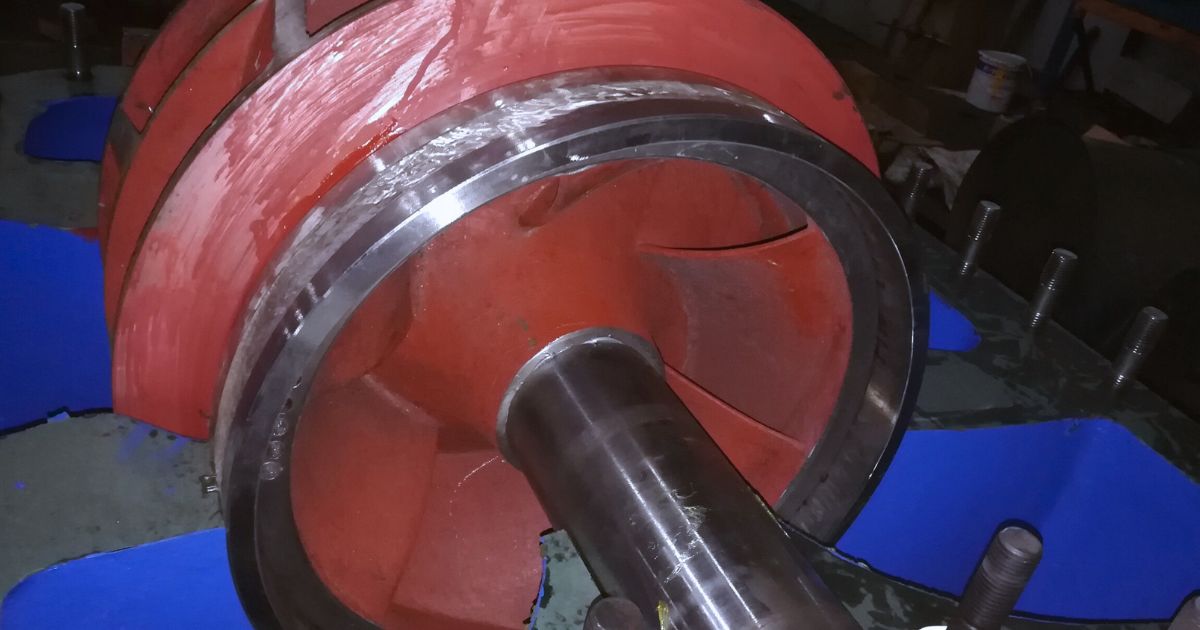
A pump wear ring is a replaceable, close-running annular ring that creates a controlled clearance between a rotating surface (usually on the impeller) and a stationary surface (usually in the casing or cover). That tight gap separates high-pressure liquid at the impeller discharge from low-pressure liquid at the impeller eye.
The point is not "zero leakage." The point is a predictable, limited leakage path that keeps the pump efficient and stable while avoiding metal-to-metal contact when the rotor deflects or temperatures move.
Wear rings are also intentionally sacrificial. You want the ring to wear so the expensive parts do not. Replacing a ring set is cheaper and faster than machining an impeller hub, sleeving a casing bore, or scrapping a casing.
If your team treats wear rings as optional, you end up paying twice: once in energy and once in reliability.
The "Internal Leak": How Wear Ring Clearance Kills Efficiency
Every centrifugal pump has internal leakage. Wear rings throttle that leakage. As the clearance opens, the pump leaks more flow from the discharge region back toward suction. That bypass flow does not leave the nozzle, but it still absorbs power.
This is the practical picture you can use on the shop floor: the pump does work on the same liquid more than once. Some of that "worked" liquid circles back through the ring clearance, gets re-energized by the impeller, and never contributes to system flow.
That loss shows up as reduced head and reduced delivered flow at a given speed, with higher brake horsepower than you expect.
Volumetric efficiency is the clean way to explain it:
- Volumetric efficiency (ηv) = useful flow out / flow generated by the impeller
- Useful flow out = impeller flow minus internal recirculation and balance leakage
As ring clearance grows, internal recirculation rises, ηv falls, and overall pump efficiency drops even if your impeller is hydraulically "fine."
After you have a baseline test, you can explain the rule of thumb to stakeholders without overselling it:
- Every time wear ring clearance doubles, you typically give up about 3 to 5 efficiency points, depending on pump specific speed and differential pressure.
- Low specific speed, high-head pumps feel it most because the pressure drop across the ring is large, so leakage becomes a bigger fraction of total flow.
If you are troubleshooting poor performance, a worn ring can mimic a wrong impeller diameter, a speed problem, or suction recirculation. The difference is you can fix rings during a planned outage.

The 2x Rule: When to Replace Your Wear Rings
You will see different replacement triggers across plants, but the simplest prescriptive rule that works in the field is the "2x Rule." When your measured clearance is about double the original (or double the new build spec), you should plan replacement unless you have a documented reason not to.
That rule is easy to defend because it lines up with what you can measure and trend. It also matches the point where performance loss becomes obvious enough that operators start compensating with throttling, bypassing, or running a standby pump.
Use replacement guidance that ties directly to what you can control at overhaul:
- As-found clearance vs. as-built clearance: your best indicator for internal recirculation growth.
- Service severity: abrasives, poor suction conditions, frequent starts, and temperature cycling accelerate wear.
- Pump sensitivity: low specific speed and high differential pressure punish you for extra clearance.
If you want a tighter trigger, many teams treat 40 to 50% growth over new clearance as "replace at this tear-down," even if the pump is still meeting minimum process demand.

The Lomakin Effect: Why Wear Rings Reduce Vibration
You can explain the Lomakin effect in one sentence: the thin liquid film in a tight wear ring clearance behaves like a hydrodynamic bearing at the impeller.
That matters because the impeller sits between bearings and is where you most need stabilizing stiffness. When the rotor deflects, the clearance becomes uneven around the circumference. Flow and pressure distribution in that annulus changes, creating a restoring hydraulic force that pushes the rotor back toward center. At the same time, fluid shear in the thin film adds hydraulic damping that resists motion.
As clearances open up, you lose both effects:
- Less stiffness at the impeller means more shaft deflection under the same hydraulic loading.
- Less damping means vibration amplitudes can grow faster, and your rotor is more likely to respond to hydraulic excitation.
This is where wear rings become a reliability part, not just an efficiency part. A pump can still "run" with worn rings, yet the rotor stability margin shrinks. That often shows up as elevated 1x vibration, a change in subsynchronous behavior, or a pump that becomes more sensitive to process changes.
Seal life is part of the same chain. More shaft motion at the seal chamber increases face motion and can disturb the fluid film at the faces. The usual outcome is higher leakage, hotter seals, and shortened seal and bearing life.
Wear Ring Materials: Preventing Galling and Seizure
Clearance decisions only work if the material pair survives real life. A tight clearance with a galling-prone metal pair is a seizure waiting to happen, especially during starts, thermal transients, or brief dry contact.
Traditional material pairs still work well in clean services:
- Bronze against stainless
- Cast iron against steel
- Stainless against stainless only when hardness and surface condition are controlled and you have rub margin
When you need tighter clearances without raising your galling threshold risk, non-galling composites enter the conversation. Engineered polymers and composites (PEEK, Vespel-type materials, carbon filled grades) can tolerate incidental rubs better than metal pairs and often let you run tighter clearances while staying stable.
After you decide on material, match it to the failure mode you are trying to prevent:
- Galling risk: avoid similar stainless pairs at tight clearances unless you control hardness, finish, and alignment tightly.
- Abrasive wear: hard coatings or hard materials can hold clearance longer, but you still need a sacrificial strategy so you do not destroy the casing.
- Thermal growth: account for differential expansion of ring and casing so your "cold" clearance does not turn into a rub at operating temperature.
The best rebuilds are not the tightest. They are the ones with a clearance and material combination that stays predictable between overhauls.
Impeller vs. Casing Rings: Understanding the Configuration
You will commonly deal with two ring locations:
Impeller rings are mounted on the rotating impeller, while casing wear rings (or cover rings) are stationary in the casing, cover, or suction side insert. Together they form the close-running seal at the impeller eye and separate discharge pressure from suction pressure.
Many pumps also include rear wear rings or balance rings that manage leakage into the back shroud cavity and influence axial thrust. Those clearances can drive thrust bearing loading, especially on designs that use balance holes.
Before you set targets, map the configuration in front of you. You want to know which clearance is controlling performance, which is controlling thrust balance, and which is most likely to rub during an upset.
A quick mental checklist helps:
- Impeller eye ring: performance driver, internal recirculation control, NPSH sensitivity at the impeller eye.
- Rear/balance ring: thrust balance driver, rotor stability contributor, common source of surprise thrust problems.
- Casing wear ring condition: ovality and erosion can make a "measured" clearance meaningless if you only check one axis.
Step-by-Step: How to Measure and Check Clearance
You cannot manage what you do not measure, and wear ring clearance measurements need to be repeatable enough to trend across rebuilds.
Start with the basics: confirm whether the spec you are using is diametral or radial. API 610 clearances are typically stated diametrally. A radial feeler gauge reading must be doubled to compare.
After you clean parts and remove burrs, use a method that matches the geometry and your shop tools.
- Verify the drawing/spec and record the target clearance as diametral.
- Inspect both ring faces for scoring, taper, and rub marks; note evidence of shaft deflection or misalignment.
- Measure ring ID and mating OD using calibrated bore gauges and micrometers, then calculate diametral clearance (ID minus OD).
- Measure at multiple clock positions (minimum four) and at two axial planes if the ring is wide; record max, min, and average.
- Check concentricity and runout at the wear ring diameter to separate true clearance from eccentric assembly.
- Compare as-found vs. as-left values and document in your history so you can correlate clearance growth with vibration and performance trends.
When you put the pump back in service, tie the measurement record to the tag and include it in your reliability review. That turns wear rings from tribal knowledge into a controlled reliability variable.
The ROI of Replacement: Energy Savings vs. Parts Cost
Wear ring replacement often pays for itself quickly, but only if you calculate it the way a maintenance manager or reliability engineer will accept: power, hours, rate, and risk.
Start with the operational symptom you can measure: higher kW for the same duty point, lower differential pressure at the same speed, or a pump curve that no longer matches baseline. If you suspect ring wear, estimate efficiency recovery conservatively, often 3 to 5 points for a major clearance deterioration, less for modest wear.
Then translate that into dollars:
- Power saved (kW) = current kW minus expected kW after repair (or baseline corrected for process conditions)
- Annual savings ($) = kW saved × operating hours × energy rate
Even small percentage changes get large when the pump runs continuously. The part cost of rings is usually minor compared to energy and the avoided cost of seal and bearing failures tied to poor rotor stability.
When you justify the work order, do not ignore reliability value. If worn rings are contributing to rotor instability, the "savings" are not only energy, they are fewer forced outages, fewer seal change-outs, and less collateral damage.
FAQs
1. What is the purpose of a wear ring in a centrifugal pump?
To provide a close-running clearance that limits leakage from discharge back to suction, protecting efficiency and acting as a sacrificial surface that protects the impeller and casing.
2. How does wear ring clearance affect pump performance?
As clearance increases, internal recirculation increases, volumetric efficiency drops, and you lose head and flow while consuming more power for the same delivered output.
3. What is the standard clearance for pump wear rings?
It depends on diameter, speed, service, and OEM guidance; many API 610 style minimum diametral clearances land around 0.010 to 0.014 inches plus diameter-based allowance.
4. What is the Lomakin Effect in centrifugal pumps?
It is the hydrodynamic bearing action created by flow through tight wear ring clearances that adds stiffness and hydraulic damping, improving rotor stability.
5. How do I know when to replace my pump wear rings?
Use measured clearance growth versus as-built spec; a common trigger is the 2x Rule, replacing when the clearance is about double the original.
6. Can I run wear rings with tighter clearances to save energy?
Yes, but only within OEM/API guidance and with the right material pair and rub margin; too tight can cause seizure during thermal growth or rotor deflection.
7. What materials are best for pump wear rings?
Best depends on service; bronze, cast iron, and stainless are common, while non-galling composites like PEEK or Vespel-type materials can allow tighter clearances and improved rotor stability.
8. What is the difference between an impeller ring and a casing ring?
An impeller ring rotates with the impeller, while a casing wear ring is stationary in the casing or cover; together they form the annular leakage restriction.
9. Does doubling the wear ring clearance double the leakage?
Often it is close in practical terms, but actual leakage depends on pressure differential, fluid properties, ring geometry, and swirl; the key point is leakage rises sharply as clearance opens.
10. Can worn wear rings cause mechanical seal failure?
Yes; worn rings reduce Lomakin stiffness and hydraulic damping, increasing shaft motion and pressure disturbances that can shorten seal life and drive leakage and heat.


